Wind turbine load measurement according to international standards and accredited procedures – for reliable technical assessments and safe operational management.
The determination of wind turbine loads offered by WIND-consult is carried out in accordance with the following specifications:
The bending and torsional moments at the tower, at the main shaft and at the blades as well as the cross acceleration of the nacelle are recorded by means of wire strain gauges at the WT. Additionally measurements of the meteorological quantities wind speed and wind direction (at hub height), air temperature, air pressure and precipitation as well as of the system parameters active power, status, pitch angle, rotational speed and position and azimut angle are carried out.
The recording of the meteorological and system quantities is carried out considering the instructions of the
- IEC 61400-12-1:2005
Wind turbines – Part 12-1: Power performance measurement of electricity producing wind turbines
- DIN EN 61400-12-1:2005
Wind turbines – Part 12-1: Measurement of the power performance of a wind turbine
The measuring bridges, applied conforming to standards, are calibrated by means of a shunt respectively defined weights. The used anemometers are calibrated in a wind tunnel according to the MEASNET guideline and all other sensors are adjusted with DAkks-calibrated reference devices. Likewise a calibration of all entries of the data logger is carried out with DAkkS-calibrated signal transmitters.
 The data are recorded with scanning rates larger than 25 Hz during the automatic measuring procedure and filed as 10-minute-files in the storage of the measuring computer.
Afterwards the data are subject to automatic and visual plausibility checks. As a result of the data analysis report files are generated, which classify the streams of data according to wind speed class (class amplitude: 1 m/s), turbulence intensity class (class amplitude: 2%), wind direction sector (evaluation sector) and the status signals. By means of these report files the selection of the streams of data is carried out, which are used for the determination of the load spectra. The capture-matrix offers a view on the number of available streams of data in the wind speed and turbulence intensity classes.
For the determination of the load spectra the time series courses are classified according to the rain-flow-procedure (amplitude-average-classification). The spectra of the wind speed bins are, if necessary, extrapolated to the fixed turbulence intensity and afterwards extrapolated to the durability. The result of the examinations are the 1 Hz equivalent loads.
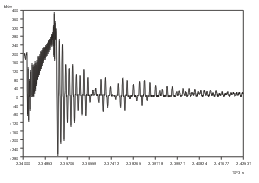
Additionally special transient events are inspected, for example start-stop-processes (The illustration shows the course of the torsional moment of the main shaft at braking.), generator change-over, emergency stop, etc..



