


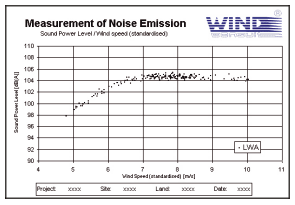
The most important acoustic parameter is the sound power level. It describes the acoustic power which is emitted by the system and is indicated as single value as well as octavo or third sound power level. The sound power level is usually stated in dependency from the field of application for different reference points (6 ms-1… 10ms-1). Important supplemental statements about the acoustic behaviour of the system are taken from the analysis of the tonality and if necessary from measurements of the impulsivity respectively the directional characteristics as well as by the subjective evaluation of the system sound.
The reproducibility and comparability of the measuring results of the acoustic parameters of the systems is also secured by round robin tests and the accreditation of the testing laboratories.

Measurement of Noise Immission
Noise immissions are influenced by noise coming from systems (e.g. wind turbines – WT) on neighbors or third. This noise influence can be disturbing.
To be able to evaluate the influence of noise immissions on the vicinity, procedures for the determination of evaluation levels by means of measurements are fixed in the standards, especially in the “Technische Anleitung zum Schutz gegen Lärm (TA Lärm)” or other national standard or requirements. The evaluation level
- is used for the comparison with the relevant standard values,
- is determined for certain evaluation times and
- contains required surcharges or reductions if necessary.
As a rule, measurements to determine the rating level are carried out at the relevant immission site (I-measurement). Often, however, measurements at the immission site are not possible for various reasons (e.g., the influence of extraneous noise, the rarity of downwind weather conditions, lack of access). These difficulties often occur in connection with WTGs, as the wind required to operate the turbines leads to increased background noise levels.
In this case, the rating level can also be determined by measurements to determine the noise immission at suitable alternative immission sites or based on the determination of the sound power level. In the latter case, the measurement results are subsequently combined with sound propagation calculations.
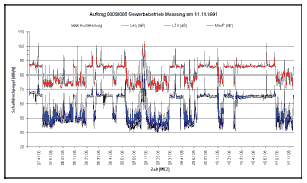
If measurements are carried out at the immission site to determine the rating levels, the time and duration of the measurement must be selected depending on the task so that the sound immissions are characteristic of the noise situation to be assessed.
For the determination of the rating level, especially in the case of WTGs and for the reasons mentioned above, the determination of the sound power and subsequent linkage with a sound propagation calculation is preferable. This is often the only way to provide the required verification within a foreseeable period, and the potential measurement uncertainties are generally lower with this approach.
The assessment period is often divided into (assessment) intervals with the same noise characteristics. The level for the entire assessment period is then determined taking into account the individual partial rating levels, the duration of exposure, the time of day of occurrence, and any surcharges to be applied. Assessment periods can be, for example:
- 8 hours at the workplace
- 16 hours for the daytime assessment period
- the most unfavorable hour during nighttime hours.
When determining the (partial) rating level, the following surcharges, for example, can be taken into account:
- tonal and impulsive characteristics
- rest periods (taking into account times of increased disturbing effect).
Measurements for special reasons, as well as initial and periodic measurements at installations requiring a permit (§ 29b BImSchG), must be carried out by a measurement body designated by the competent supreme state authority.
